Ruby
Saipan Humane Society photo
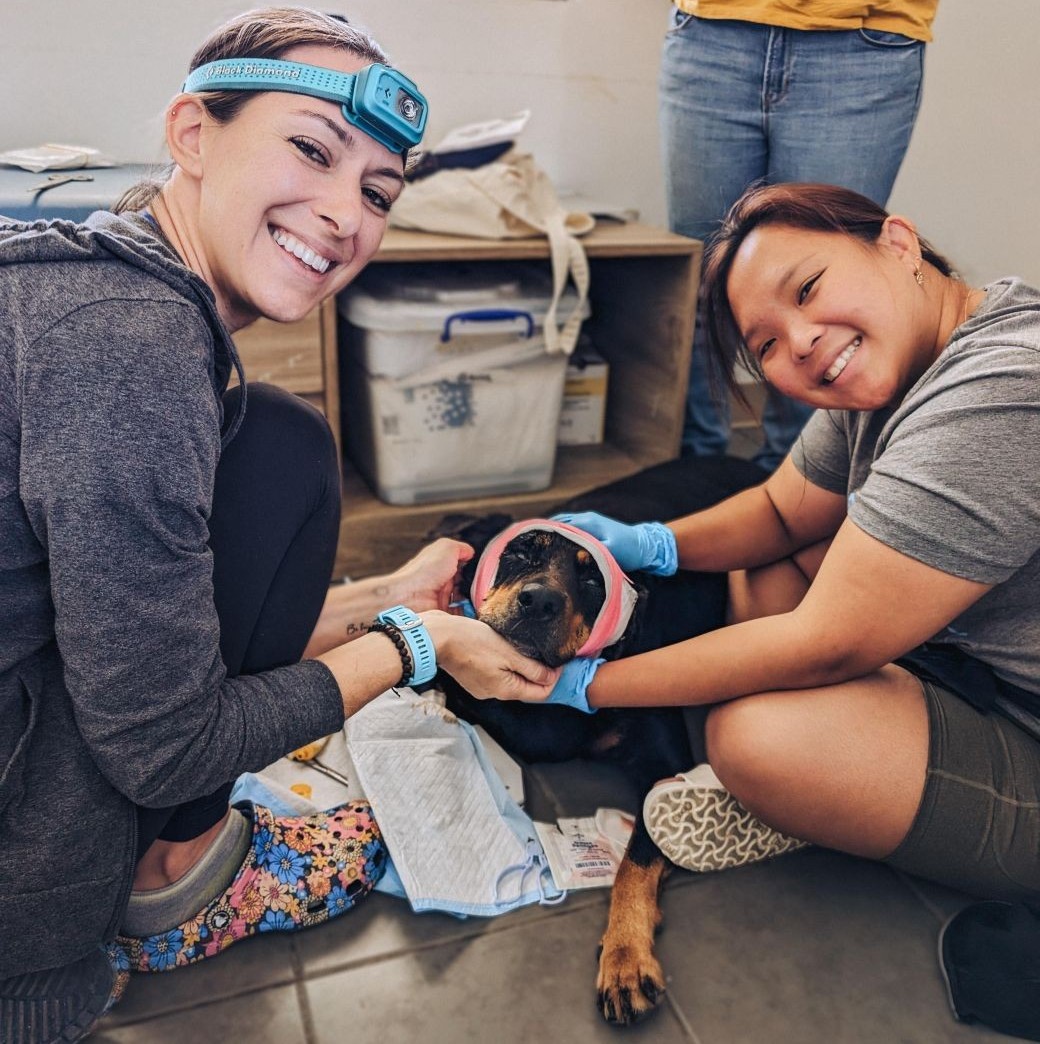
Lauren Cabrera (left) and Ruby Ma cofounded Saipan Humane Society (SHS) in 2023 to fill the animal care gap on Saipan.
On a crisp, blue-sky autumn day, Lauren Cabrera sits at Pups & Cups Cafe, a go-to study spot in the college town of Pullman, Washington. Two and a half months into her first year of veterinary school, Cabrera is studying on her iPad and slipping treats under the table to her dog, Cleo.
Like every other veterinary student who frequents this cafe, Cabrera, sporting a maroon Washington State University College of Veterinary Medicine sweatshirt, has a lot of schoolwork to do.
Unlike her peers, she already has started a veterinary clinic, where she will work after she graduates in 2029 — 5,800 miles away.
Cabrera came to Pullman from Saipan, an island in the Commonwealth of the Northern Mariana Islands (CNMI), which is located east of the Philippines and north of Papua New Guinea. Cabrera's decision to attend veterinary school was fueled by need in her adopted home — Saipan does not have a single resident veterinarian.
A nurse practitioner originally from New Hampshire, Cabrera, 36, may not seem an obvious candidate for the island's veterinarian. She first moved to the Northern Mariana Islands in 2012, initially to Saipan, and her transition into animal care came about a decade later.
She and her husband were living and working on Guam when the Covid-19 pandemic hit. On maternity leave at the time, Cabrera had trouble securing child care due to pandemic constraints, making it difficult to return to her hospital job. To pivot, she started a dog rescue.
In addition to people's pets, the canine populations on Saipan and Guam include tens of thousands of free-roaming mixed-breed dogs. Some, like Cleo, find homes, but without reproduction control, the supply seems never-ending.
In 2022, Cabrera and her family moved back to Saipan. There, Cabrera realized that her interest in rescuing animals had become a passion.
"I was supposed to start working in the hospital as a nurse practitioner, and I just visited the shelter and got involved there and started thinking, 'Maybe I'm not returning to the hospital. Maybe I'm starting down a different path,' " Cabrera recounted. "It all kind of fell into place."
Cabrera got a job as the Northern Mariana Islands' animal health manager, and, in 2023, cofounded the Saipan Humane Society (SHS), an animal health clinic.
Without a veterinarian of its own, the nonprofit organization relies on visiting veterinarians and virtual consults, along with nonveterinarian staff trained to do basic exams.
"They see anywhere between 20 and 50 pets a day," Cabrera said. "So it's pretty busy, with very little resources [and] a small team."
The CNMI, comprised of 14 islands, has been a United States territory since 1986. Of the approximately 47,000 people in the territory as of the 2020 census, 43,000 people live on Saipan. The island of Guam is part of the same archipelago but is a separate U.S. territory.
Saipan was not always without a veterinarian — the island's single practitioner, Dr. Edgar Tudor, retired several years before SHS was founded. He published a commentary in a local newspaper about his departure, suggesting that the difficulty of maintaining an economically viable practice on the island may inhibit the territory from finding his successor.
Another clinic opened after Tudor's retirement, but it shuttered after a few years due to financial difficulties, according to Cabrera.
The travel expenses of SHS's visiting veterinarians are funded by the Banfield Foundation.
SHS first reached out to the foundation in 2023, and since then, the Banfield Foundation has sent 22 volunteers — a mix of veterinarians and veterinary technicians — and is currently building its 2026 volunteer schedule to continue the support, said Lacey Frame, community and field clinic programs manager for the foundation.
Frame, a veterinary technician, visited Saipan herself.
"By personally visiting Saipan and working with the team, I can identify what skillset would be most beneficial in a visiting doctor and match up interested volunteers," she told the VIN News Service by email.
map_Mariana Islands_cms_resizeto_280x679.202512012 - Caption. [Optional]

In addition to sending volunteers, the Banfield Foundation has supported the clinic with over $300,000 in cash and supplies.
"I think without them, we would be in rough shape, for sure," Cabrera said.
But a permanent veterinarian is necessary for comprehensive animal care. Cabrera speaks plainly about the limitations of care in the absence of a full-time veterinarian.
"We have a lot of surgical needs," she said. "[If] a dog breaks a leg, either we sedate him and we wrap it with cast padding and hope it turns into something somewhat functional, or if there's not a vet coming and it's really bad, they're going to get put down."
Recruitment and retention of personnel from overseas is difficult across the board for the commonwealth, said Jack Ogumoro, director of the Division of Agriculture for the CNMI Department of Lands and Natural Resources. He's seen hires in other fields last for only a short time.
"After a year or two, they go back home, and then we're back to square one," Ogumoro said.
As someone who is not from the islands but has spent years building connections on Saipan and Guam, Cabrera is careful not to dictate or lecture residents on animal care.
"My approach has always been to listen first," she said. "I try to understand how people see their animals or animals in the community. What are their priorities? What resources do they actually have access to? What is realistic? How can we work together to improve the health of the island, people and animals here? Effective solutions only work if they come from that shared understanding, rather than trying to impose outside ideas."
Although clearly a central player in Saipan's effort to access veterinary care, Cabrera is one of a cohort of people on and off the island who are working to fill the critical need.
Addressing the care scarcity
When SHS first opened, Guam's territorial veterinarian, Dr. Mariana Turner, assumed the role of volunteer medical director and helped the clinic establish protocols to provide care while awaiting intermittent visits from veterinarians.
"We were trying to figure out how do we do this but also keep it to a high level of care," Turner said. She outlined a series of situations in which nonveterinarians could appropriately provide care and how to do so, and identified circumstances under which a veterinarian must be consulted.
"We developed a pretty extensive protocol manual for the standard things that they see," she said.
Take canine parvovirus in puppies. SHS has a set of criteria for staff to identify cases as mild, moderate or severe, what treatments to use and when to consult a veterinarian.
Ruby Ma, cofounder of the clinic with Cabrera, runs the day-to-day operations, supervising a staff of five. Ma, too, is in school, taking an online program to become a veterinary technician.
"From the beginning, Lauren and I already decided we're going to divide and conquer," Ma said, explaining that she is drawn to the hands-on work of technicians. "So we decided she's going to be a vet, I'm going to be the nurse, [and] we can team up and provide more service."
On a typical day, SHS staff conduct exams using the protocols Turner helped establish. They collect patient histories, take vitals and visually document the visit.
DrCoakleyBanfield
SHS photo
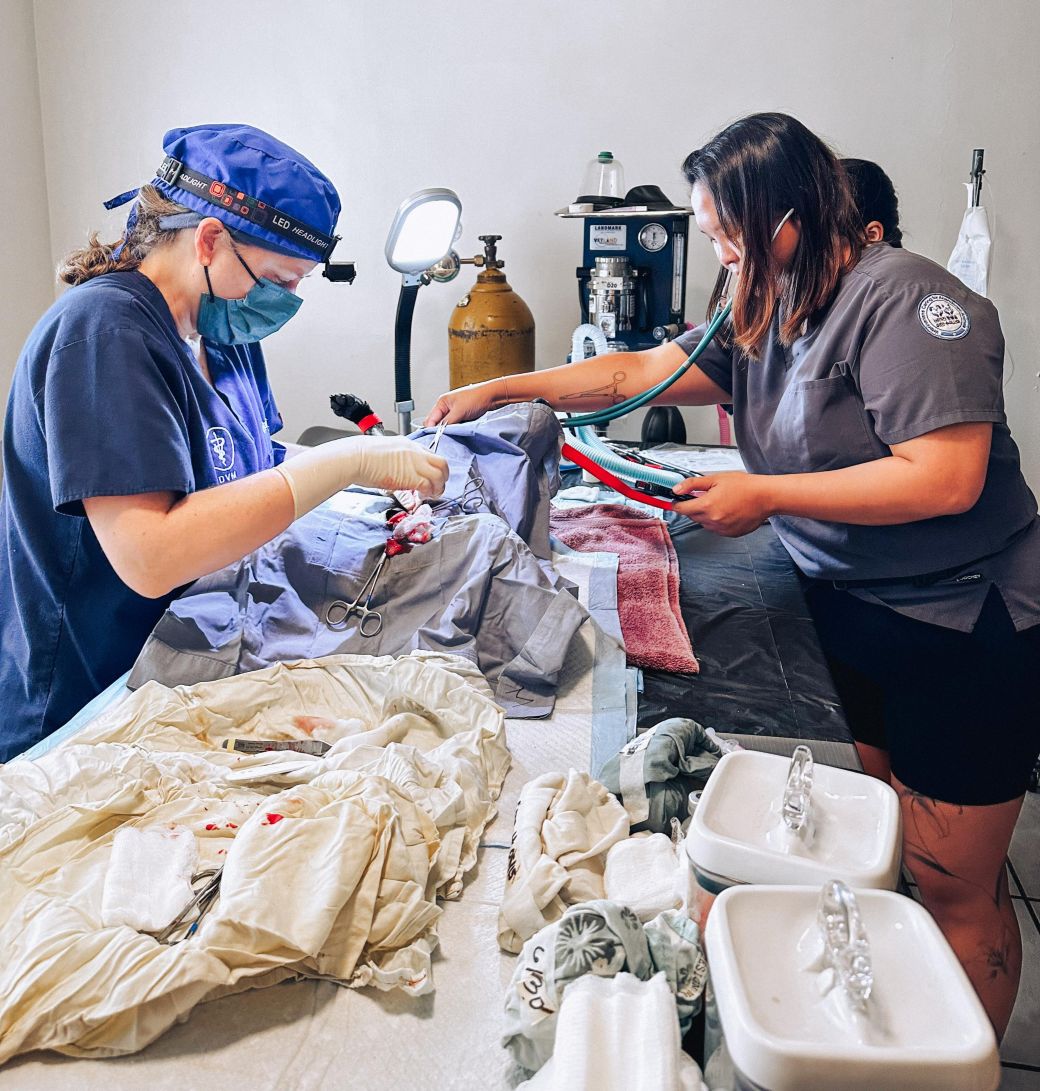
SHS depends on volunteer virtual and visiting veterinarians, such as Dr. Mariah Coakley (left), who is assisted in a procedure by Ma. Coakley has been to Saipan three times.
"When we are doing [a] sick consultation, we'll check on the [patient's] temperature, heart rate, respiratory rates, and then take all kinds of pictures and video to show exactly what's the main concern of the consultation," Ma recounted.
Ma and the team then share the information with a volunteer virtual-consult veterinarian. The veterinarian might prescribe medication or recommend further diagnostics. SHS does not have certain tools, such as a radiography machine to take X-ray images, but it does have a centrifuge and a microscope.
"Relying on virtual support is, I think, a hot topic in vet med, but without that, there would literally be nothing, because Saipan Humane Society can't pay a vet," Cabrera said. "Telemedicine has really saved us in so many ways."
After the virtual consult, Ma will schedule a follow-up appointment. "When we follow up, [if] they're still not doing exactly well, we'll schedule them as soon as the visiting vet is here," Ma said.
Dr. Mariah Coakley, a veterinarian in Texas, has been to Saipan three times since 2023 as a volunteer. A few days of each two-week visit are spent on individual cases. She remembers in one instance she had to amputate a dog's leg. Due to the delay in veterinary care and because she could not get a look at the injury on an X-ray image, other treatment options weren't possible.
"The lack of X-ray is difficult, just because you can't really assess fractures and have limited treatment options for repair," Coakley said.
A significant part of a visit is spent doing spay and neuter clinics. Coakley said she was able to do 15 to 30 surgeries per day during her last visit.
"They are very good about getting people signed up," Coakley said. "They would coordinate with me: 'How many can we do this day?' and 'How many can we do this day?' and then they would just fill those appointment slots once we figured out how much help we had and how much supplies we had and things like that."
The number of free-roaming dogs makes reproductive control a priority for the island, Turner said. On Guam, 6,000 dogs must be sterilized per year for 10 years to hit its goal of 85% sterilization, she said. Currently, they can desex about 5,000 annually. There is no similar estimate established yet for Saipan.
In addition to her job on Guam, Turner serves as the interim territorial veterinarian for the Northern Mariana Islands, a role that Cabrera will step into when she returns with her degree.
WSUsimlab
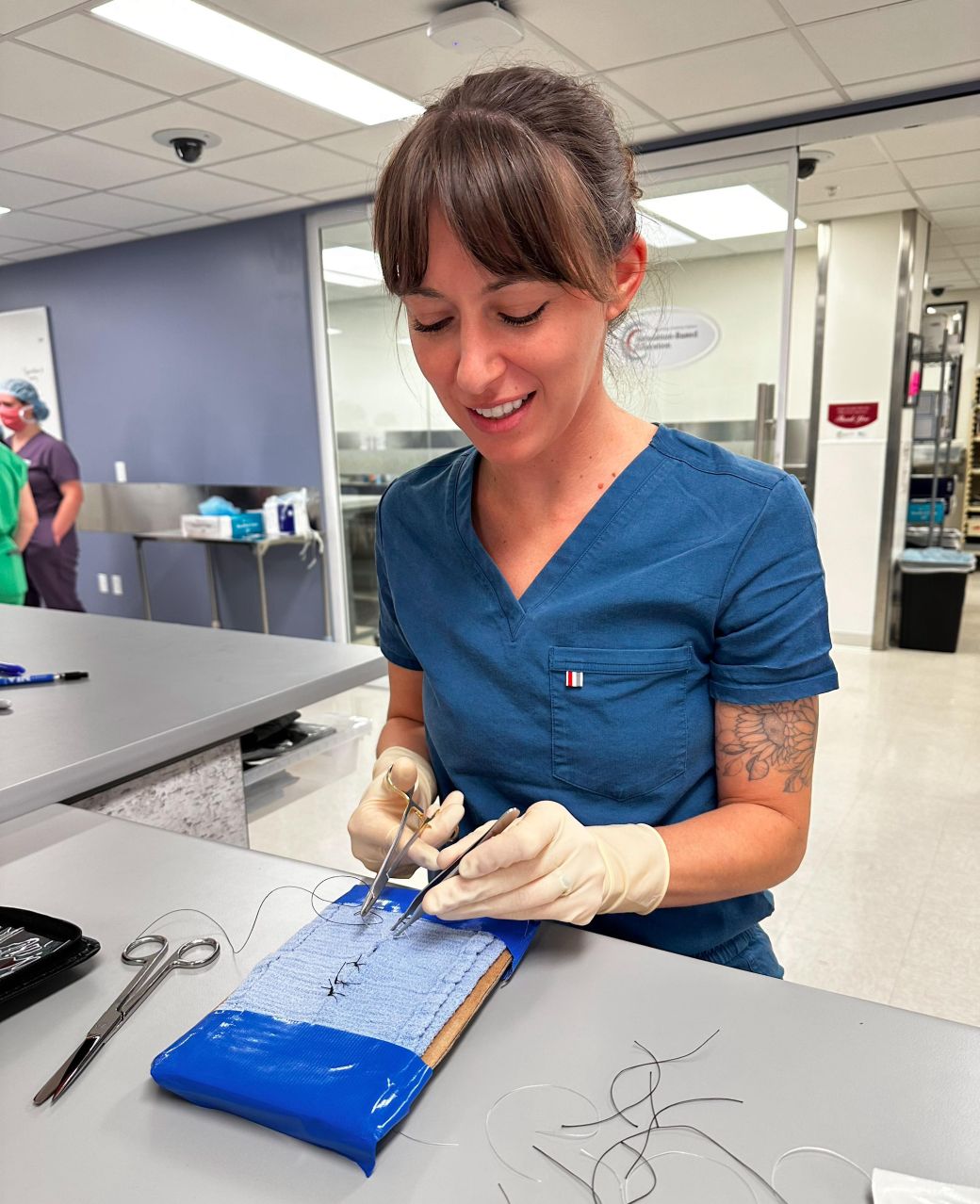
Photo courtesy of Lauren Cabrera
Now a first-year veterinary student at Washington State University, Cabrera practices suture technique at the school's Clinical Simulation Center.
As territorial veterinarian, Turner reviews import/export documents for animals moving on or off the islands, oversees monitoring for avian influenza and is in charge of other matters concerning both human and animal health. Turner believes that having one veterinarian on Saipan probably won't be enough.
"The more that I grow the programs and see where the gaps are and what we need to build, the more it's like, well, we need more than one vet to be able to cover all the stuff that really needs to happen," she said.
Cabrera agrees but doesn't know how they'd fund a second doctor, as SHS can't afford even one full-time veterinarian.
For that reason, Cabrera will be working three overlapping jobs when she returns to the island. She'll resume her role as the Northern Marianas' animal health manager, take the position of territorial veterinarian and be SHS's resident veterinarian.
It's also important that she achieve a veterinary degree without taking on the heavy debt common among veterinary students today — no small feat. The estimated cost of attendance at the WSU veterinary school is $233,244 for four years for Washington residents (and more for nonresidents).
Although not a Washington resident, Cabrera was able to access the resident tuition rate through a program called the Western Interstate Commission for Higher Education, or WICHE. She also won a scholarship from the U.S. Department of Agriculture, through its NextGen program. NextGen supports the development of future agricultural professionals, and Cabrera's scholarship was one of several funded by a $10.8 million grant to Northern Marianas College. The scholarship covers Cabrera's tuition and some living expenses. She is taking out relatively modest loans to pay the remainder of her living expenses.
With this financial support, Cabrera is now fully immersed in the first-year veterinary school curriculum. She's adapting to Pullman life — she recently obtained a heated vest for Cleo, so her island dog won't get cold when she sees her first snow — and she has formed connections with other students in her class.
"I really want to make sure that there's not another time in the future of the CNMI where there's no veterinarian."